
Karma
Overview
Skills
Brand Identity
Game Design
Year
2025
Timeline
8 Weeks
Team Members
Noah Wood
Problem
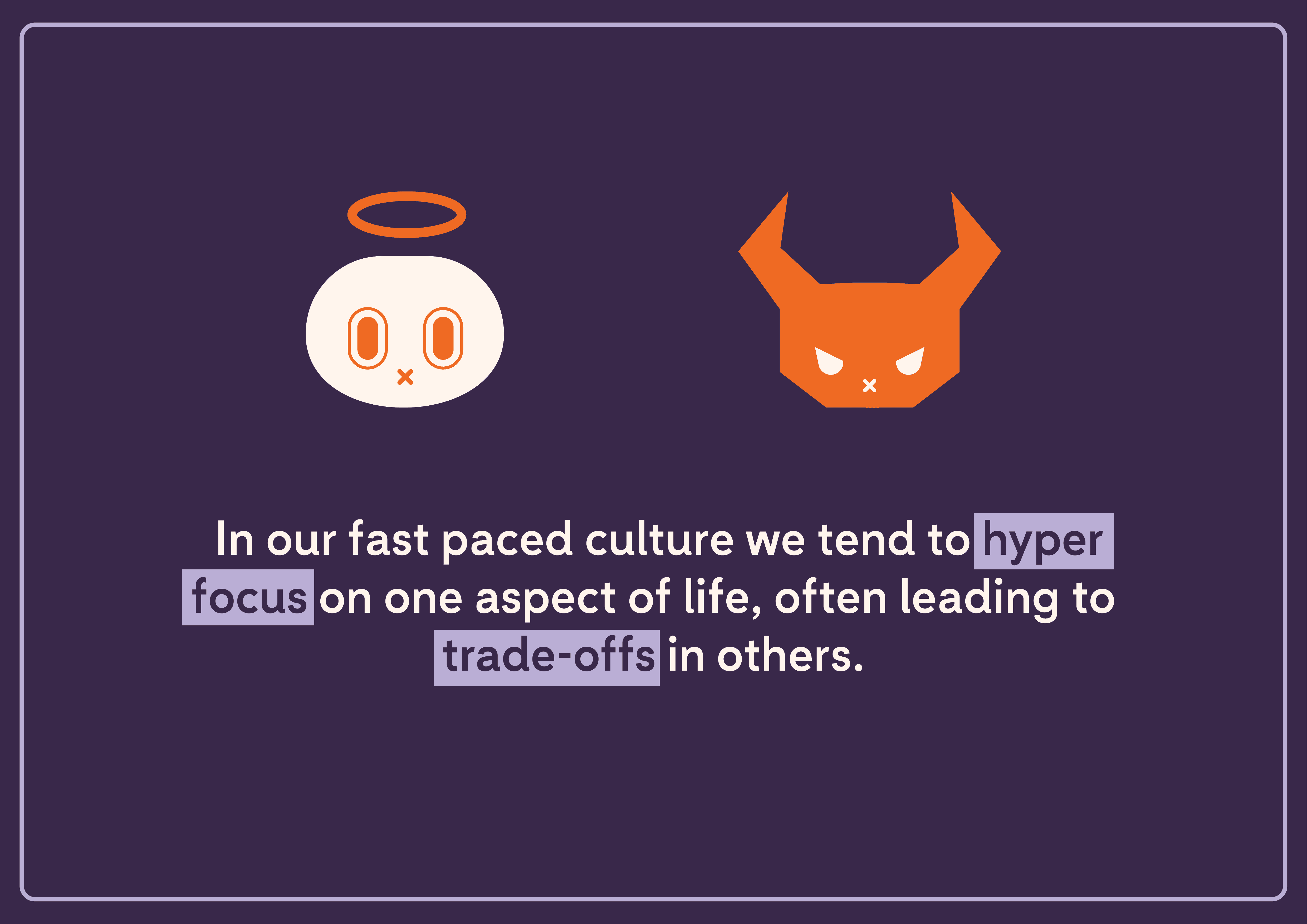
In today’s fast paced culture, people often rush into life choices without pausing to consider their consequences. Nearly two thirds of Gen-Z report struggles across health, career, and relationships, so focusing too heavily on one area often creates trade offs in another. This early stage of life is full of transitions such as entering work, managing independence, and forming identities, making it natural for priorities to differ between individuals. This highlights the need for self reflection, helping young adults make purposeful choices and remain aware that every decision they make shapes different outcomes.

Process
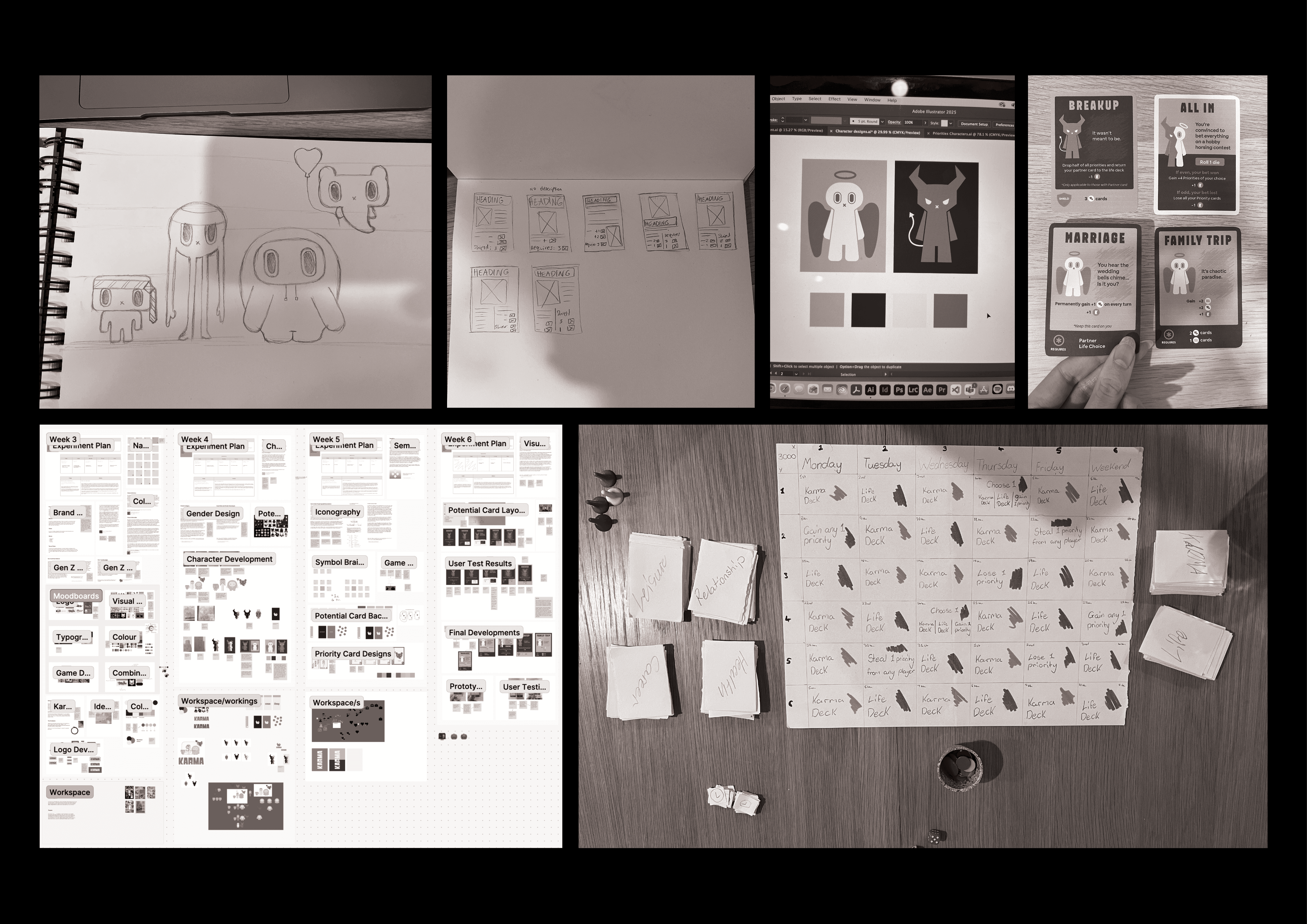
‘Karma’ was designed using multiple different theories to guarantee the effectiveness of the game design and user experience. I delved into theories such as colour, iconography, and character design to help with gameplay and memorisation of core game elements. User testing was key when checking the readability and general playability of the game.
Outcome
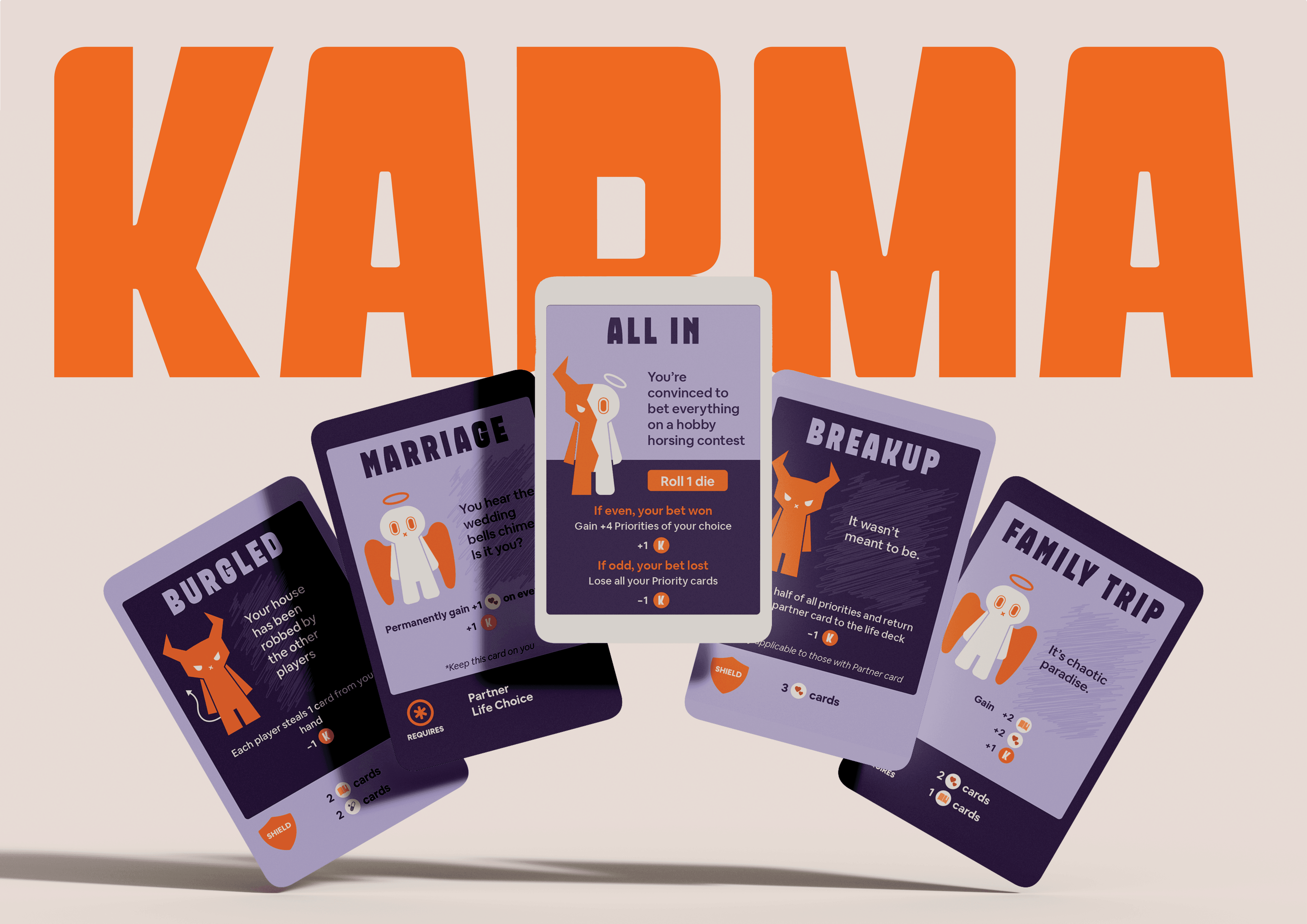
‘Karma’ is a board game designed to help you reflect on your priorities and decide where best to spend your time. However, just like life, karma gets in the way to shake things up. My role in this project was to create the game's brand identity and visual assets, including the box and card designs, icons, and characters. My aim was to ensure players could easily understand the purpose of each card through clear visual hierarchy, readability, colour coding, and iconography, supporting intuitive gameplay and visual recall. My team member Noah Wood's role was the game mechanics and user experience of the game, ensuring players would simultaneously understand the rules, while still enjoing gameplay.


The ‘Karma’ game manual designed by Noah Wood outlines the rules and different card types throughout the game.

There are two decks of cards that players draw from: The Life Deck, full of Life Choice cards, and the Karma Deck, full of good and bad Karma cards.

Karma cards act as a way for players to either gain or lose Karma points. Karma points are what you need to win the game, so each time you draw a Karma card, it’s a gamble on what you’ll get. To protect yourself against bad Karma, you need to meet the ‘Shield’ requirement, similar to ‘Requires’ on the good Karma cards. With Gen-z as the target audience, the copy and card visuals resolved around their strong inclination for relatability, dark humour, and nostalgia through engaging characters.

Life Choice cards are what you would typically spend your time on everyday. Some cards cost more time than others if they require more attention. Each Life Choice card allows you to gain different priorities on your turn, which then help go towards earning more Karma points. To earn a Karma Point through your priority cards, you need to gain 5 of the same Priority cards, or two of each kind of Priority card.


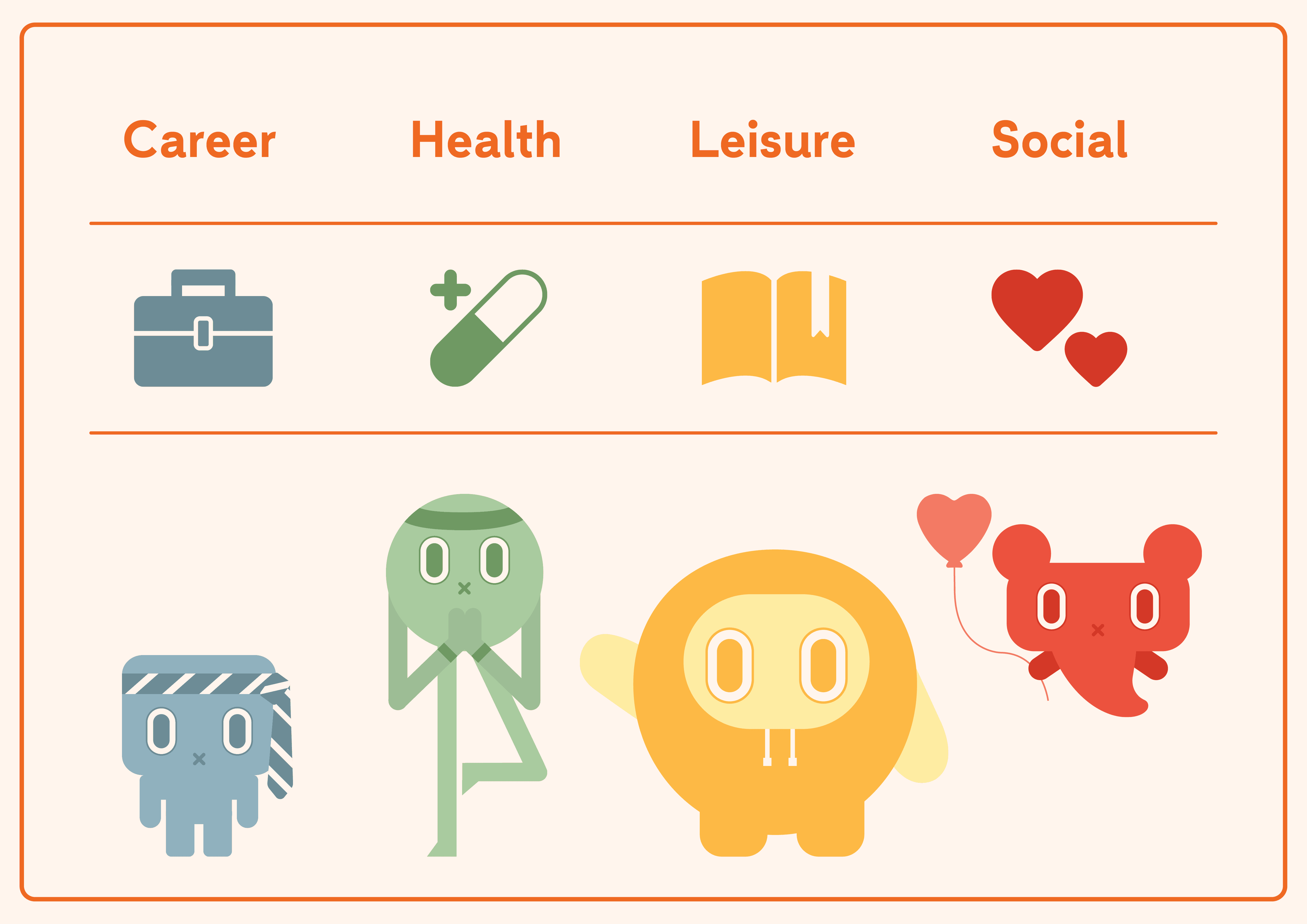
Different characters were designed for each priority category (Career, Health, Leisure, and Social). Gender design was researched to ensure the characters remained gender neutral and avoided any bias or stereotypes. Iconography was also explored, showing that icons Improve engagement and learning, along with effecting how players interpret and make decisions during game play. The icons had to be designed to ensure clear readability and visual resemblance of the different categories to better gameplay. Colour coding of each priority was crucial to differentiate each category, ultimately allowing for better identification. It was discovered that including colour coding improves memory and attention, while creating more engagement.
Through ‘Karma, the aim was to create a game that encourages reflection and engagement around the topic of prioritisation in a subtle way that allows players to take away key learnings and apply them to their own lives. Games bring people together and create discussions, a healthy way to introduce and explore issues constructively. Through studies exploring colour, gender design, semiotics, iconography, and information hierarchy, Learning Experience Design was conducted to create an engaging tabletop game focused on life choices and priorities.